Commercial Roof Refurbishment
Restore Waterproofing Performance Without Costly Roof Replacement
Commercial roof refurbishment restores waterproofing performance, extends service life and protects building assets without the cost, disruption and programme delays associated with full roof replacement. Spray-applied coating systems provide seamless, durable protection across metal roofs, asbestos roofs, flat roofs and industrial buildings.
Before Refurbishment Recommendations Are Made
An independent site survey is the essential first step. It provides the technical data needed to determine if refurbishment is viable and which system is appropriate for your specific roof.
- Condition assessment
- Water ingress investigation
- Corrosion review
- Coating adhesion assessment
Recommended First Step: Survey
A professional site survey provides the technical foundation for all specification and project decisions. It determines whether refurbishment is viable and which systems are appropriate.
What Is Commercial Roof Refurbishment?
Commercial roof refurbishment is the process of restoring and protecting existing roof structures without complete removal and replacement. Instead of stripping the existing roof, specialist spray-applied coating systems are applied directly to the prepared substrate, creating a seamless, waterproof membrane that extends service life and restores performance.
Refurbishment is suitable for roofs experiencing leaks, corrosion, coating failure, ponding water or general weathering — provided the underlying structure remains sound. The approach offers significant cost savings, reduced programme time, minimal operational disruption and avoids the waste generation associated with full roof replacement.
Forti Nova supports commercial roof refurbishment through technical assessment, system specification and approved applicator connection. Every project begins with a site assessment to determine substrate condition, suitability for refurbishment and appropriate system selection.
Across commercial roof refurbishments of every scale — from single-unit industrial roofs to large warehouse estates and multi-site portfolios — the same pattern holds: confirm substrate condition before specifying any system. Portfolio-based refurbishment programmes are typically phased to fit operational constraints while reducing reactive maintenance spend across the whole estate.
Common Commercial Roof Problems
Roof Leaks
Water ingress through roof membranes, flashings, penetrations or seams causing internal damage and operational disruption.
Corrosion
Cut edge corrosion, rust staining and substrate degradation on metal roofs compromising waterproofing integrity.
Cut edge corrosion guideCoating Failure
Delamination, flaking, blistering or chalking of existing coatings requiring remediation or replacement.
Ponding Water
Standing water on flat roofs indicating drainage issues and potential membrane degradation.
Asbestos Deterioration
Weathering, cracking or damage to asbestos cement sheets requiring encapsulation or management.
Not sure what's causing your roof problem? A Forti Nova-supported site assessment will identify the root cause, determine whether refurbishment is suitable, and recommend the appropriate system for your specific roof type and condition.
Roof Refurbishment vs Full Replacement
Roof Refurbishment
- Often significantly less disruptive and less wasteful than full replacement
- Programme completed in days rather than weeks
- Minimal operational disruption — works can often proceed while building remains in use
- No roof strip-out, skip hire or waste disposal costs
- Seamless waterproofing membrane with no joints or seams
- 15–35 year warranty pathways depending on system selected
- Environmentally preferable — avoids landfill waste
Full Roof Replacement
- Significantly higher capital expenditure
- Extended programme — often several weeks
- Major operational disruption — building may need to vacate
- Roof strip-out, skip hire and waste disposal costs
- Multiple trades and coordination required
- Weather-dependent programme with higher risk of delays
- Significant waste generation sent to landfill
Decision Framework: Refurbishment is typically suitable when the roof structure is sound but the waterproofing layer has deteriorated. Replacement may be required when there is significant structural degradation, widespread moisture ingress into insulation, or compliance requirements that cannot be met through refurbishment. A site assessment will determine the appropriate approach for your specific building.
Typical Roof Types We Refurbish
Metal Roofs
Profiled steel and aluminium roofs including standing seam, box profile and corrugated systems.
Asbestos Roofs
Asbestos cement sheet roofs requiring encapsulation and weatherproofing protection.
Flat Roofs
Built-up felt, single-ply membranes, concrete decks and other flat roof constructions.
Industrial Roofs
Manufacturing facilities, warehouses and industrial buildings with varied roof constructions.
Warehouse Roofs
Large-span warehouse and distribution centre roofs requiring cost-effective refurbishment.
Suitable Coating Systems
Liquid Rubber SprayGrade
Two-component spray-applied waterproofing membrane for large-area commercial roof refurbishment. 15-year product warranty. 600m²+ per day application rate.
Prokol TopSpray 35
High-build spray-applied coating for profiled metal cladding and roofs. Up to 25-year warranty pathway. RAL colour matching. UV-resistant finish.
Rocathaan Hotspray PA 260-FR
KIWA certified pure polyurea waterproofing system. 35-year warranty pathway (subject to specification and manufacturer approval). Specialist heated spray application. BRoof (t4) and BRoof (t2) certified.
System Selection: The correct system depends on substrate type, roof condition, performance requirements, budget considerations and warranty pathways. A Forti Nova technical assessment will determine the most appropriate system for your specific project requirements.
Commercial Roof Refurbishment Projects
Spray-applied waterproofing across commercial buildings


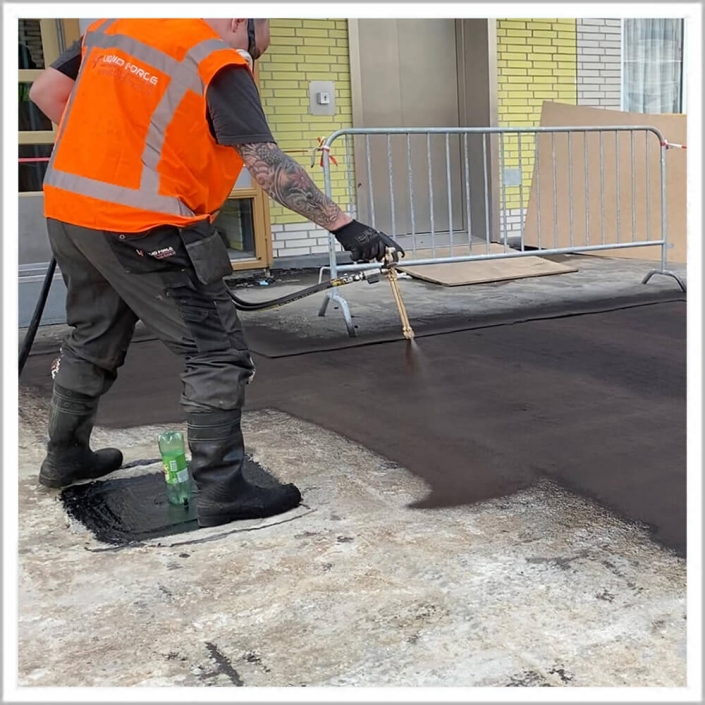
Operative in hi-vis vest applying spray-applied waterproofing membrane to a concrete deck surface at ground or podium level.
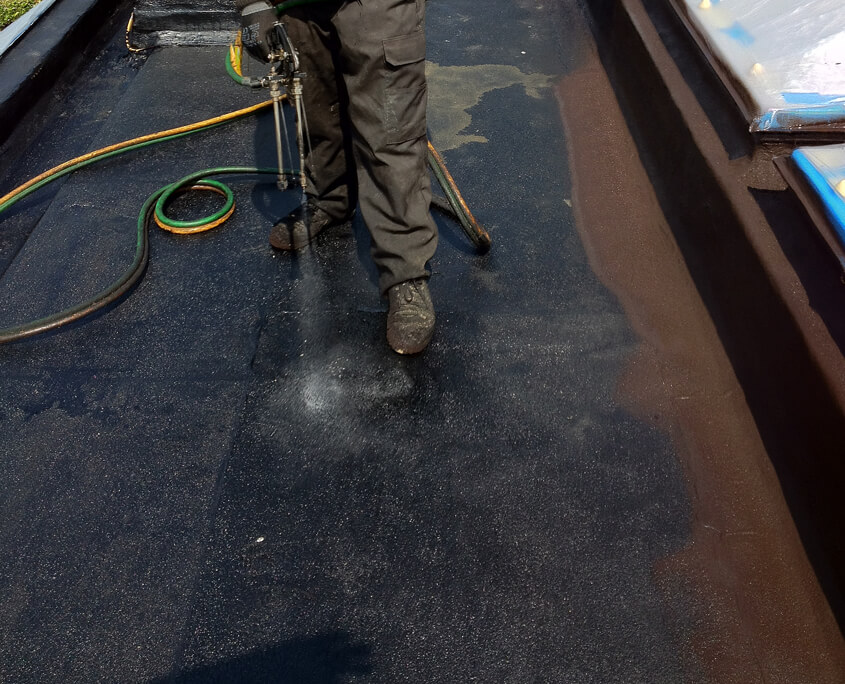
Close-up of operative applying spray waterproofing membrane to a flat roof surface, showing wet coating application adjacent to rooflight detail.
Industrial building roof waterproofing in progress — spray-applied membrane at ridge and valley
Technical Review & Specification Basis
- Guidance on this page is provided by Forti Nova, the operator behind SprayMyCladding.
- System recommendations for commercial roof refurbishment are based on survey-led assessment, substrate condition, access requirements and intended service environment.
- Manufacturer product guidance is considered where SprayGrade, TopSpray 35, ProFix or Rocathaan Hotspray systems are relevant to a project.
- Suitability is not assumed from photographs, building age or building type alone. A site assessment is required before specification or quotation.
Roof condition, corrosion extent, coating adhesion and access method are all assessed on-site before any system is proposed.
Next Steps
Request Site Assessment
Submit your details and a Forti Nova-supported approved applicator will contact you to arrange a site visit. The assessment will identify roof problems, substrate condition and suitability for refurbishment.
Technical Specification
Based on the assessment findings, Forti Nova will recommend the appropriate coating system, outline the scope of works and provide project pricing.
Approved Applicator Delivery
Once specified, the project will be delivered by a Forti Nova approved applicator trained in spray application, substrate preparation and system installation.
Commercial Roof Refurbishment: Decision Guidance
When is refurbishment more appropriate than replacement?
Refurbishment is appropriate when the existing roof substrate remains structurally sound — no perforation, no widespread corrosion, and laps and fixings are intact. Replacement is necessary where sheets have perforated, structural integrity is compromised, or fire safety recladding is required. Key conditions favouring refurbishment: • Facilities managers need to avoid operational disruption • Asset managers are deferring capital expenditure • Lifecycle extension of 15–35 years is the objective
How is suitability normally assessed?
A qualified building surveyor or approved applicator carries out a roof condition survey. The survey assesses substrate integrity, lap and fixing condition, drainage adequacy, and any active water ingress routes. Findings are documented with photographic evidence. The survey then recommends whether refurbishment or replacement is appropriate. Portfolio managers commissioning surveys across multiple buildings should request standardised reporting formats.
What causes commercial roof deterioration?
Common causes of commercial roof deterioration include: • UV degradation of factory-applied or spray-applied coatings • Cut edge corrosion on profiled steel sheets • Failed lap sealants allowing water ingress • Thermal cycling causing movement and cracking • General weathering over time Planned maintenance programmes can identify and treat problems before water ingress occurs.
What happens if roof problems are ignored?
Untreated roof deterioration leads to water ingress. This causes internal damage to stock and equipment, mould growth, accelerated corrosion of structural elements, and operational disruption. Repair costs increase significantly the longer problems persist. Active leaks require urgent assessment.
What systems are commonly specified?
System selection depends on substrate condition and project objectives: • Liquid Rubber SprayGrade — large-area waterproofing, asbestos encapsulation, budget-efficient refurbishment • Prokol TopSpray 35 — appearance-led refurbishment, warranty pathways up to 25 years • ProFix — cut edge corrosion treatment and localised repairs Building surveyors determine which system is appropriate based on assessment findings.
What factors influence project cost?
Project cost is influenced by: • Roof area (large roofs benefit from economies of scale) • Substrate condition (poor condition requires more preparation) • Access requirements (MEWP vs scaffold vs rope access) • Preparation scope and system specification Preparation represents a significant portion of total cost. It is essential for long-term performance.
How much operational disruption should be expected?
Most commercial buildings remain fully operational during refurbishment. Application is external. Weather windows are factored into programme planning. For buildings with racking, loading bays or refrigeration plant, site logistics should be confirmed during the assessment. Approved applicators specialise in programmes with operational constraints.
When should a roof survey be commissioned?
A roof survey should be commissioned when: • Leaks are identified or coating deterioration is visible • Asset lifecycle planning requires condition data • Refurbishment vs replacement decisions are needed Facilities managers typically commission surveys as part of planned maintenance programmes. Survey cost is often credited against subsequent refurbishment works.
How do building owners extend asset life?
Asset life is extended through planned refurbishment programmes that restore weatherproofing and protect substrates from further deterioration. Systems such as SprayGrade and TopSpray 35 provide 15–35 year warranty protection. This defers capital expenditure, reduces maintenance costs, and improves portfolio performance metrics.
Can asbestos roofs be refurbished without removal?
Yes. Asbestos cement roofs can be encapsulated using Liquid Rubber SprayGrade. Encapsulation seals fibres in situ, restores waterproofing, and avoids the cost and disruption of licensed removal. It is typically significantly less expensive than removal and replacement. A site assessment confirms substrate suitability.
What warranty pathways are available?
Warranty depends on system specification: • Liquid Rubber SprayGrade — 15-year product warranty • Prokol TopSpray 35 — up to 25 years (subject to specification compliance) • ProFix — up to 10-year protection for cut edge treatment Warranty validity requires adherence to manufacturer maintenance guidance.
What maintenance is required after refurbishment?
Post-refurbishment maintenance typically includes annual visual inspection, biennial cleaning, and reactive repairs for any localised damage. Regular maintenance protects warranty validity. It also ensures the envelope delivers the expected lifecycle extension. Maintenance guidance is provided at project handover.
Who This Service Is For
Commercial roof refurbishment is typically commissioned by asset managers, facilities managers and building owners responsible for maintaining commercial or industrial buildings. It is appropriate where the roof structure is sound but waterproofing has degraded, coatings have failed, or active water ingress is present.
Asset Managers
Managing commercial property portfolios requiring planned maintenance, lifecycle extension and capital expenditure deferral. Roof refurbishment extends envelope life and supports asset management planning.
Facilities Managers
Responsible for building performance and maintenance spend. Refurbishment resolves active roof defects, eliminates water ingress and reduces reactive maintenance costs.
Building Owners
Protecting property value and maintaining watertight building envelopes. Refurbishment delivers long-term protection at a fraction of replacement cost, with minimal disruption to building occupiers.
Regional Coverage
Forti Nova supports commercial roof refurbishment projects across the UK through its approved applicator network. Regional assessment pages are available for the North West, Yorkshire and the Midlands — covering common building types, typical survey findings and system guidance for each area.
Sectors Served
Commercial roof refurbishment is carried out across all commercial and industrial sectors. Programme planning and system selection account for sector-specific operational constraints.
Commercial Roof Refurbishment Decision Support
Evidence-based guidance for capital expenditure planning, system specification and lifecycle extension strategies. All recommendations grounded in site-specific assessment.
Metal Roof Refurbishment Cost
Cost factors for metal roof coating projects. Roof area, corrosion extent, preparation and specification.
Roof Coating vs Replacement
Decision framework for building owners evaluating coating against replacement.
Roof Coating Systems Guide
System selection framework comparing TopSpray 35, SprayGrade, ProFix and Rocathaan.
Ponding Water On Commercial Roofs
Causes, risks and remediation options for flat roof drainage issues.
Commercial Cladding Refurbishment
Adjacent cluster head for combined roof and cladding programmes and facade restoration projects.
Commercial Authority Note: These resources support capital expenditure planning, system specification and contractor selection. All refurbishment decisions should be grounded in a site-specific assessment carried out by a qualified surveyor or approved applicator.
Is Your Roof Suitable for Refurbishment?
Request a site assessment to determine whether commercial roof refurbishment is suitable for your building. A Forti Nova-supported approved applicator will assess substrate condition, identify problems and recommend the appropriate system.