Liquid Rubber® SprayGrade
Liquid Rubber® SprayGrade is a water-based, VOC-free, two-component spray-applied membrane for large-area commercial waterproofing and protection. It cures immediately into a seamless, permanently flexible membrane and is used across roofing systems, cladding, asbestos sheets, concrete, bitumen, PVC and other suitable substrates.
Why SprayGrade Was Selected
System selection follows survey findings. The decision logic below shows why SprayGrade progressed and why alternatives did not.
Large-area roof or cladding refurbishment (>2,000m²)
Area efficiency and 600m²+/day application rate make SprayGrade cost-effective for large buildings where programme timeline matters.
Asbestos cement roof requiring encapsulation
SprayGrade is the primary system for HSE CAR 2012-compliant asbestos encapsulation without removal — seals fibres, restores weatherproofing.
Mixed substrates requiring single specification
Broad substrate compatibility addresses steel, aluminium, composite and fibre cement within a single specification — reduces complexity.
Waterproofing priority over appearance
Where weather protection is the primary objective and appearance is secondary, SprayGrade delivers cost-efficient refurbishment without premium coating costs.
Alternative Systems Considered
TopSpray 35 not selected: Appearance-led refurbishment, RAL colour matching or 25-year warranty pathway were not project requirements. TopSpray 35 is specified where corporate estate standards, brand alignment or premium appearance outcomes are needed.
Rocathaan Hotspray not selected: Pure polyurea waterproofing, KIWA certification or BRoof fire classification were not specified. Rocathaan is reserved for technically demanding projects requiring specialist certification.
ProFix not selected: Defects were widespread across the roof/cladding area, not localised. ProFix addresses individual leaks, penetrations and detailing — not large-area refurbishment.
Findings That Would Exclude SprayGrade
- • Substrate perforation from corrosion — panels that have corroded through require section replacement before any coating
- • Active water ingress through structural routes (failed laps, missing flashings) — mechanical repair must precede coating
- • Fire safety recladding requirements — coating cannot change fire performance classification
- • Thermal upgrade requirements — SprayGrade is weatherproofing, not insulation
- • Appearance-led specification (corporate estate, brand colours) — TopSpray 35 provides RAL colour matching
- • BRoof fire classification required — Rocathaan Hotspray provides BRoof (t4)/(t2) certification
What Is Liquid Rubber® SprayGrade?
Liquid Rubber® SprayGrade is a two-component spray-applied coating system. Both components are water-based and combine at the spray gun immediately before application, allowing the material to cure rapidly and form a seamless, fully adhered, flexible waterproofing membrane.
It is used for commercial and industrial waterproofing, protection and refurbishment where large areas need to be treated efficiently. The system is VOC-free, cold-applied, and safe alternative to conventional hot-applied or solvent-based systems.
Every SprayGrade application is carried out by a Forti Nova approved applicator — trained in two-component spray application, substrate assessment, surface preparation and system specification.
Application Method
SprayGrade is applied using a two-component spray system. The Liquid Rubber material and B-component are connected separately to the pump and combined through a dual spray gun immediately before reaching the surface.
A trained applicator can typically apply 600m² or more per day, depending on project conditions, access, detailing and substrate preparation. Additional protection or insulation can usually be applied around 20 minutes after application. Full adhesion develops within 48 hours.
Coverage & Membrane Thickness
SprayGrade coverage depends on the required membrane thickness and project specification. For waterproofing applications, the primary figure is 2.7kg/m².
Suitable For
Commercial roof refurbishment
Where substrate is structurally sound and primary deterioration is weathering, coating degradation or general wear.
Commercial cladding refurbishment
Profiled steel, aluminium, composite panel and fibre cement cladding where substrate remains sound.
Asbestos cement roof encapsulation
HSE CAR 2012-compliant encapsulation where sheets are structurally suitable.
Mixed substrate buildings
Multiple substrate types (steel walls, fibre cement soffits, composite panels) addressed in single specification.
Flat roof waterproofing
Concrete decks, profiled metal, composite panels, asbestos cement, existing felt or single-ply (with preparation).
Mid-life refurbishment
Buildings being maintained to extend to next major investment cycle — cost-effective protection.
Not Suitable For
Structural perforation
Panels corroded through require section replacement before coating.
Active ingress through structural routes
Failed laps, missing flashings — mechanical repair must precede coating.
Fire safety recladding requirements
Coating cannot change fire performance classification.
Thermal upgrade requirements
SprayGrade is weatherproofing, not insulation.
Appearance-led specification
RAL colour matching, corporate estate standards — TopSpray 35 is appropriate.
BRoof fire classification required
Rocathaan Hotspray provides BRoof (t4)/(t2) certification.
Residual Risks Remaining After Selecting SprayGrade
Appearance is not restored
SprayGrade provides weatherproofing protection but does not restore colour or appearance. Where corporate estate standards, brand alignment or appearance-led outcomes are required, TopSpray 35 should be considered.
Fire classification not specified
SprayGrade is a weatherproofing membrane. Where BRoof fire classification is a project requirement, Rocathaan Hotspray provides BRoof (t4) and BRoof (t2) certified performance.
Thermal performance not improved
SprayGrade is not an insulation system. Where thermal upgrade is required, insulation must be installed separately or as part of a composite specification.
Structural defects not addressed
SprayGrade cannot restore structural integrity. Where substrate perforation or structural deflection exists, mechanical repair or replacement must precede coating.
When Coating Systems Should Not Be Considered
The following survey findings do not indicate that a different coating system should be selected. They indicate that no coating system should be proposed until structural issues are resolved — or that refurbishment itself may not be the correct route.
Substrate perforation across significant area
Where corrosion has progressed through the full sheet thickness across more than localised areas, no coating system can restore structural integrity. Section replacement or full re-roof review is required before any coating programme can be scoped.
Active ingress with unidentified structural source
Where water ingress is active and the structural entry point has not been confirmed, applying any coating system before source identification risks encapsulating a defect rather than resolving it.
Structural movement or deflection confirmed
Where purlins, steelwork or the roof structure show signs of deflection or settlement, coating cannot address the underlying structural condition. An engineer review must precede any refurbishment specification.
Asbestos sheets structurally compromised
Where asbestos cement sheets are fractured, perforated or non-integrally fixed, encapsulation is not appropriate. Licensed removal and replacement review is required under HSE CAR 2012 before the encapsulation route can be considered.
Fire safety upgrade mandated by regulation
Where a building requires fire performance recladding under current regulations, no spray-applied coating changes the fire performance classification of the panel assembly. Recladding is the only compliant route.
End-of-useful-life condition confirmed by survey
Where a surveyor concludes the building envelope has reached end-of-useful-life — widespread adhesion failure, through-thickness corrosion, structural compromise — the correct recommendation is replacement review, not a coating specification.
These findings would be identified during a site assessment. Forti Nova does not propose refurbishment programmes where survey findings indicate that coating is not the appropriate route. Where these conditions are confirmed, the assessment outcome is an honest recommendation — not a system specification.
Technical Review & Specification Basis
- Guidance on this page is provided by Forti Nova, the operator behind SprayMyCladding.
- SprayGrade suitability depends on roof condition, substrate preparation, project environment and manufacturer guidance from Liquid Rubber Europe.
- System selection is confirmed through site assessment — substrate type, waterproofing objectives, access requirements and project scale all influence whether SprayGrade is the appropriate specification.
- Suitability is not assumed from photographs, building age or building type alone. A site assessment is required before specification or quotation.
Liquid Rubber SprayGrade is a Liquid Rubber Europe product. Forti Nova supports project delivery through assessment, specification guidance and approved applicator connection.
Approved Applicator Delivery
SprayGrade is applied by Forti Nova's approved applicator network. All applicators are trained in spray application techniques, substrate assessment, surface preparation and system specification.
Forti Nova provides technical support, specification guidance and approved applicator connection. The approved applicator model ensures that SprayGrade is applied correctly, to the required film thickness, and in accordance with the system specification.
Request a Site Assessment
Determine whether SprayGrade is suitable for your specific building and project requirements.
SprayGrade Application Examples


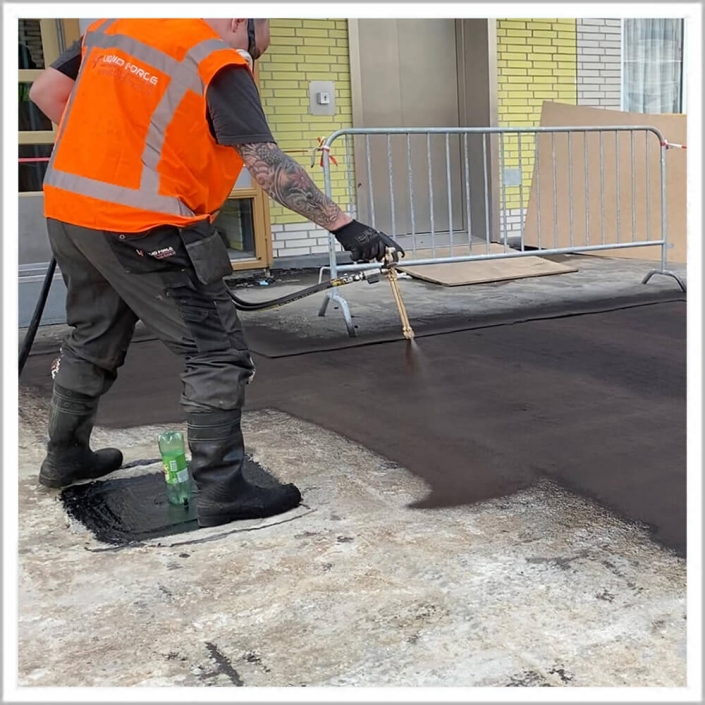
Operative in hi-vis vest applying spray-applied waterproofing membrane to a concrete deck surface at ground or podium level.
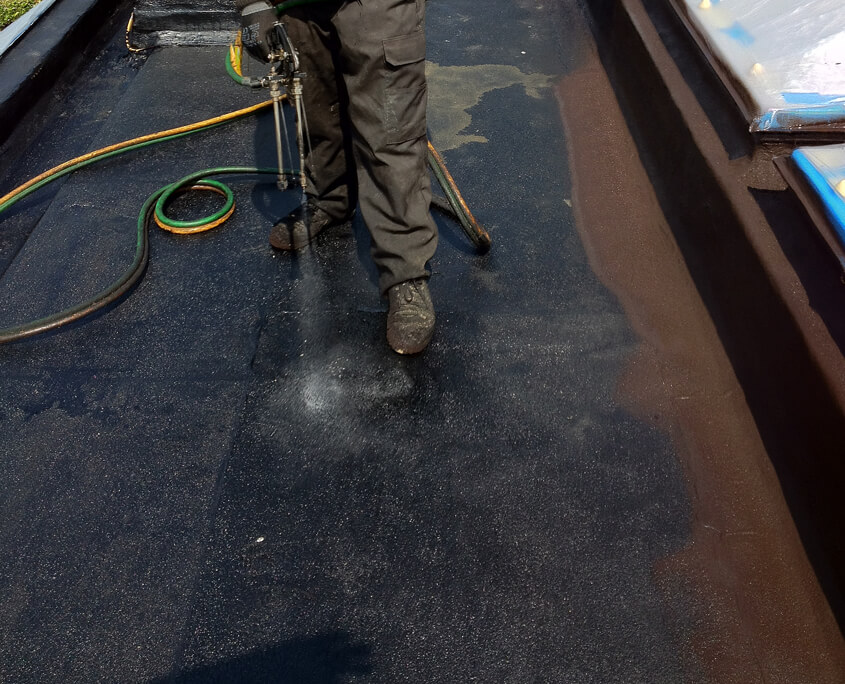
Close-up of operative applying spray waterproofing membrane to a flat roof surface, showing wet coating application adjacent to rooflight detail.
Industrial building roof waterproofing in progress — spray-applied membrane at ridge and valley
Who This System Is For
SprayGrade is typically specified by asset managers, facilities managers and building owners managing large commercial or industrial buildings where waterproofing performance and programme efficiency are the primary objectives.
Asset Managers
Managing commercial property portfolios requiring cost-effective envelope refurbishment at scale. SprayGrade's high application rate and broad substrate compatibility support multi-building programmes.
Facilities Managers
Eliminating water ingress, restoring weatherproofing and extending building service life on occupied sites. Cold-applied, no hot works permit, minimal disruption to building operations.
Duty Holders (Asbestos)
Managing asbestos cement roofs under CAR 2012 where a competent assessment confirms the sheets are suitable. SprayGrade can contain the existing surface without removing the sheets.
Related Problems
SprayGrade may be appropriate where the following conditions have been identified — subject to professional assessment confirming substrate suitability.
Related Applications
SprayGrade is used across a range of commercial and industrial refurbishment applications.
Related Resources
Refurbishment vs Replacement
Decision pathway for refurbishment vs replacement.
Commercial Cladding Refurbishment Costs
Cost factors and budget considerations.
How Long Do Cladding Coatings Last
Lifespan factors and performance expectations.
Can Commercial Cladding Be Coated
Substrate suitability assessment guidance.
Need SprayGrade or another specialist waterproofing system?
SprayGrade, pure polyurea HotSpray, asbestos encapsulation, below-ground waterproofing and wider commercial coating technologies are handled through Liquid Coatings by Forti Nova.
What problem are you actually trying to solve?
My commercial roof has widespread leaks across a large area — when is SprayGrade the right kind of solution?
SprayGrade is relevant where the main requirement is large-area waterproofing and the existing substrate is still suitable for refurbishment. The leak sources, substrate condition, joints, outlets and local defects still need to be identified first; a membrane should not be used to hide structural failure or unresolved drainage problems.
The asbestos cement roof is weathered but still structurally sound — can it be encapsulated instead of removed?
Potentially, yes. SprayGrade can form part of an asbestos roof encapsulation strategy where the sheets remain suitable and the work follows the required asbestos management and preparation methodology. Fractured, perforated or structurally compromised sheets need a different route.
Water is ponding on the roof — will SprayGrade fix the standing water problem?
Not by itself. A waterproof membrane can protect a suitable substrate, but it does not create missing falls, unblock outlets or correct structural deflection. The cause of ponding needs to be dealt with before or alongside the waterproofing specification.
The roof is still wet after rain — can SprayGrade be applied straight onto it?
No. The substrate needs to meet the system's application conditions and should not be wet or frozen. Weather, temperature, cleanliness and moisture all matter because the membrane is only as reliable as the surface it is applied to.
Some sheets are perforated with corrosion — can SprayGrade bridge over the holes?
No. A coating cannot restore lost sheet strength or replace missing material. Perforated or materially weakened areas require repair or replacement before the waterproofing system is completed.
We have thousands of square metres to refurbish and cannot afford a slow programme — is SprayGrade suited to scale?
Yes, this is one of its strongest use cases. Trained applicators can achieve high daily outputs on suitable large areas, but real productivity is governed by preparation, detailing, access and weather rather than the spray rate alone.
The building has several different roof substrates — does SprayGrade help with mixed-surface refurbishment?
It can be useful because it is specified across a broad range of compatible substrates, but each substrate still needs its own preparation and compatibility check. Mixed materials should not be treated as though they are technically identical.
Should I choose SprayGrade or TopSpray 35 for a metal roof?
Choose by the problem. SprayGrade is primarily a waterproofing membrane where water-tightness and large-area application are the main objectives. TopSpray 35 is the stronger fit where protective recoating, colour restoration and long-term appearance on suitable metal surfaces are the priority.
I want the 15-year warranty — is buying SprayGrade enough to get it?
No. Warranty depends on the complete project route: substrate suitability, preparation, application, required build-up and compliance with manufacturer requirements. Product choice alone does not qualify an unsuitable roof for warranty.
We keep repairing the same leaks locally — when should we stop patching and consider a full membrane?
When defects are widespread and the underlying roof remains suitable for refurbishment, repeated local patching can become less sensible than a properly specified large-area membrane. A survey should establish whether the problem is distributed waterproofing failure or whether the leaks actually come from a smaller number of joints, outlets or structural defects.