TECHNICAL ANSWER
What is the colour (liquid) for Liquid Rubber HBS200?
Brown to black. Cures to black seamless membrane.
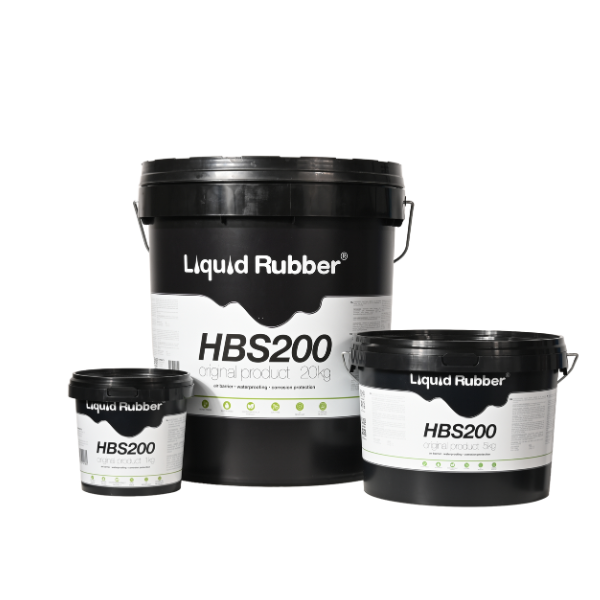
HBS200 is the high-build liquid waterproofing route for compatible gutters, seams, joints and local roof details. It is a cold-applied, water-based, solvent-free coating that cures to a flexible black membrane — a different job from ProFix's fast temporary local leak repair.


Per the Liquid Rubber TDS: 1.35 kg/m² produces approximately 1 mm cured membrane (airtight); 2.7 kg/m² produces approximately 2 mm (waterproof).
It can be suitable for gutter, seam and joint waterproofing where the substrate and defect are compatible and correctly prepared on a dry surface.
No. The Liquid Rubber TDS states HBS200 should be applied to a dry surface. Do not apply to wet surfaces or directly before rain.
No. The Liquid Rubber TDS confirms it is water-based, contains no solvents and no VOC.
Start with the defect, not the product name. That is the safest way to understand whether this system belongs on the job.
Suitable where the gutter substrate and defect can be prepared and a seamless high-build waterproofing layer is appropriate.
Can form part of a reinforced local waterproofing build-up where joints and cracks require treatment before the main membrane coats.
Useful for compatible roof details that need a cold-applied seamless flexible membrane rather than a decorative cladding finish.
Manufacturer data supports protective coating use on compatible concrete and ferrous materials, subject to preparation and specification.
Do not assume suitability. Manufacturer application guidance calls for a dry, clean surface; HBS200 is not the underwater-repair product.
Not the answer. Failed decking, unstable metal, through-corrosion or structural movement must be addressed before coating.
HBS200 is a modified elastomeric bituminous emulsion — a water-based, solvent-free, single-component high-build waterproofing and air-barrier coating by Liquid Rubber. Cold-applied and quick-setting, it cures from a brown/black liquid to a seamless black flexible membrane with excellent strength, elasticity and adhesion. Used as a protective coating to prevent water and corrosion damage, as an air barrier, and for rust protection of ferrous materials. The high viscosity allows it to cover small cracks and coat vertical surfaces. CE marked according to EN 1504.
commercial gutters, roof details, seams, joints, compatible concrete and ferrous material protection, and local waterproofing where a cold-applied seamless membrane is appropriate.
Confirm whether ingress is through the coating or detail, or caused by drainage, structural movement or a failed substrate.
Apply to a dry surface free from dirt, debris, oil and grease. At joints or cracks, a fabric reinforcing layer may be recommended. Do not apply if heavy rain is imminent.
Apply in thin coats — 1.35 kg/m² for 1 mm (airtight) or 2.7 kg/m² for 2 mm (waterproof). Dries to touch in approx. 1 hour; fully cured in 24 hours. Degrease between coats during curing.
Useful product data should answer a question, not sit in a wall of specification cards. These answers use the current technical information for Liquid Rubber HBS200.
Brown to black. Cures to black seamless membrane.
1.35 kg/m². Airtight seal.
2.7 kg/m². Waterproof membrane.
53–58%. Liquid product.
850%. ASTM D638 typical result.
>90%. ASTM D638.
Passed >1,200 hours. ASTM B117-09.
Passed >250 hours. ASTM G-155.
0.0004 L/(s·m²) at 75 Pa. ASTM E2178.
Passed. ASTM C1305.
None. Water-based, solvent-free.
3.7 n/mm². Cured membrane.
2.7 n/mm². Cured membrane.
Approx. 1 hour. Temperature and humidity dependent.
24 hours. Temperature and humidity dependent.
CE — EN 1504. CPR EU 305/2011.
Per the Liquid Rubber TDS: 1.35 kg/m² produces approximately 1 mm cured membrane (airtight); 2.7 kg/m² produces approximately 2 mm (waterproof).
It can be suitable for gutter, seam and joint waterproofing where the substrate and defect are compatible and correctly prepared on a dry surface.
No. The Liquid Rubber TDS states HBS200 should be applied to a dry surface. Do not apply to wet surfaces or directly before rain.
No. The Liquid Rubber TDS confirms it is water-based, contains no solvents and no VOC.
HBS200 carries a Declaration of Performance under the Construction Products Regulation (CPR) EU 305/2011 according to EN 1504.
The technical facts are already above. These answers start with the leak, defect or site condition so it is clear when Liquid Rubber HBS200 belongs in the solution — and when it does not.
It can be suitable where the gutter remains structurally sound and the leaks come from compatible seams, joints or surface waterproofing defects. The substrate must be dry and correctly prepared; badly perforated metal, failed falls or structural movement are not solved by simply coating over them.
No. The Liquid Rubber TDS states HBS200 should be applied to a dry surface and should not be applied directly before rain. If the repair must be made while the detail is only lightly moist, a different product route such as ProFix may be more appropriate for a temporary local repair.
Do not assume so. At joints or cracks a reinforcing fabric may be recommended as part of the build-up. First identify whether the defect is a surface crack, a moving joint, a failed connection or structural damage, then follow the project specification.
No. The TDS supports HBS200 as a high-build waterproofing coating on compatible substrates including concrete, and reports adhesion data for concrete. Suitability still depends on the actual defect, dryness, stability and preparation of the surface.
HBS200 is used for protection of ferrous materials, but it is not a licence to coat loose corrosion or structurally weakened steel. Remove defective material and establish whether the steel remains sound before applying the waterproofing build-up.
No. Repeated failure is a sign to diagnose the wider cause. Check gutter falls, outlets, movement, perforation, failed joints and substrate condition. HBS200 is useful when the problem is one the membrane can actually solve; it should not mask a drainage or structural defect.
Per the current Liquid Rubber TDS, approximately 2.7 kg/m² is used for a 2 mm waterproof membrane. That is the technical consumption figure; real project quantities should also account for detailing, surface profile and wastage.